





Copyright © 2026 NOVABEYOND LIMITED (company number 2833487). All rights reserved.
Address: UNIT 616 6/F KAM TEEM INDUSTRIAL BUILDING 135 CONNAUGHT ROAD WEST SAI WAN HONGKONG.
As the global mobile ecosystem matures, the boundaries between app distribution and web advertising are being redefined. With tighter privacy regulations, stricter platform review systems, and growing restrictions from app stores, PWA (Progressive Web App) and W2A (Web-to-App) models are emerging as key alternatives for advertisers and agencies seeking scalable and compliant growth.
However, this transformation also brings new challenges. How to balance policy compliance, technical flexibility, and account stability has become a central question for advertisers and cross-border agencies alike.
This article explores the logic, applications, compliance implications, and strategic account setups behind the PWA/W2A trend , and how agencies can integrate these models into their ad account systems for long-term growth.
From Apps to the Web: The Evolution Behind PWA / W2A
Traditional mobile advertising relies heavily on app stores, where users click an ad, download an app, install, and register before taking action. This long conversion path often results in high friction, low retention, and compliance risks.
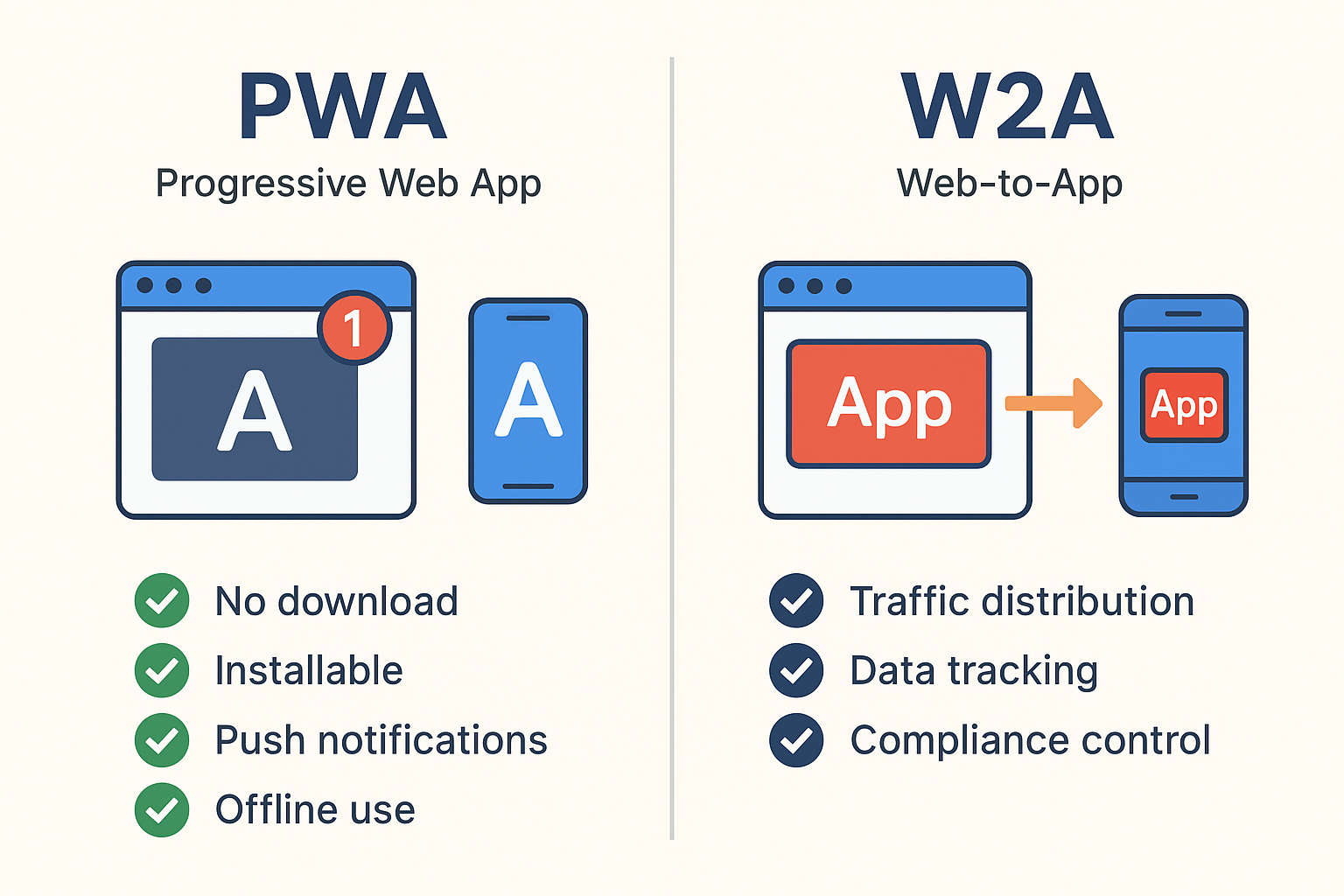
The rise of PWA and W2A represents a smarter, lighter, and more compliant way forward.
● PWA (Progressive Web App) delivers app-like user experiences directly via a browser. It combines the flexibility of web pages with native app functions: no download required, installable, push-enabled, and usable offline.
● W2A (Web-to-App) refers to a structured funnel that redirects web traffic into native app installs or actions, typically through a compliant bridge page that allows tracking and policy management.
Simply put: PWA makes the web behave like an app. W2A makes the web the compliant gateway to an app.
In a landscape where regulatory compliance defines competitiveness, this "lightweight, low-risk, high-conversion" approach is rapidly becoming the go-to growth model for agencies managing international ad accounts.
Why PWA / W2A Is Becoming the Core of Compliance Strategy
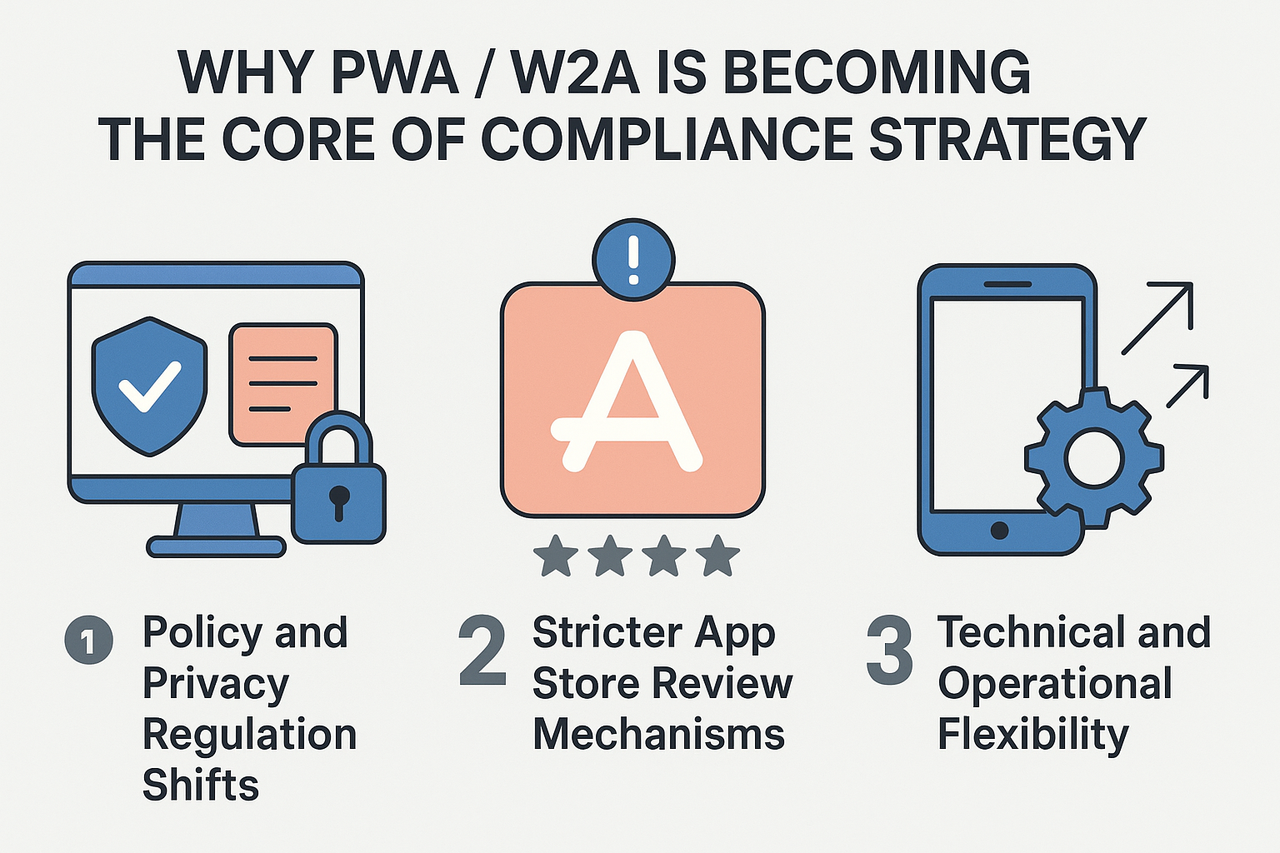
1. Policy and Privacy Regulation Shifts
Global data protection laws such as GDPR (EU) and CCPA (California), along with stricter policies from major platforms like Google, Meta, and TikTok, have significantly raised the compliance threshold for app-based advertising. PWA/W2A models provide a compliant alternative by minimizing exposure to sensitive user data collection.
2. Stricter App Store Review Mechanisms
Google Play and the App Store have intensified scrutiny, especially for sensitive categories such as finance, gaming, and utilities. Through W2A/PWA flows, advertisers can test markets, validate demand, and scale operations, all within legal and platform-safe boundaries.
3. Technical and Operational Flexibility
Compared to native apps, PWAs are faster to deploy, easier to update, and can run directly as landing pages. W2A systems add flexibility to user journeys, supporting dynamic redirects, localized content, and precise audience segmentation, empowering agencies to manage compliance and performance at scale.
Leveraging PWA/W2A for Account Compliance, Content Quality, and Regional Expansion
For advertising agencies, PWA/W2A is not merely a technical tactic but a structural approach to account stability and compliance.
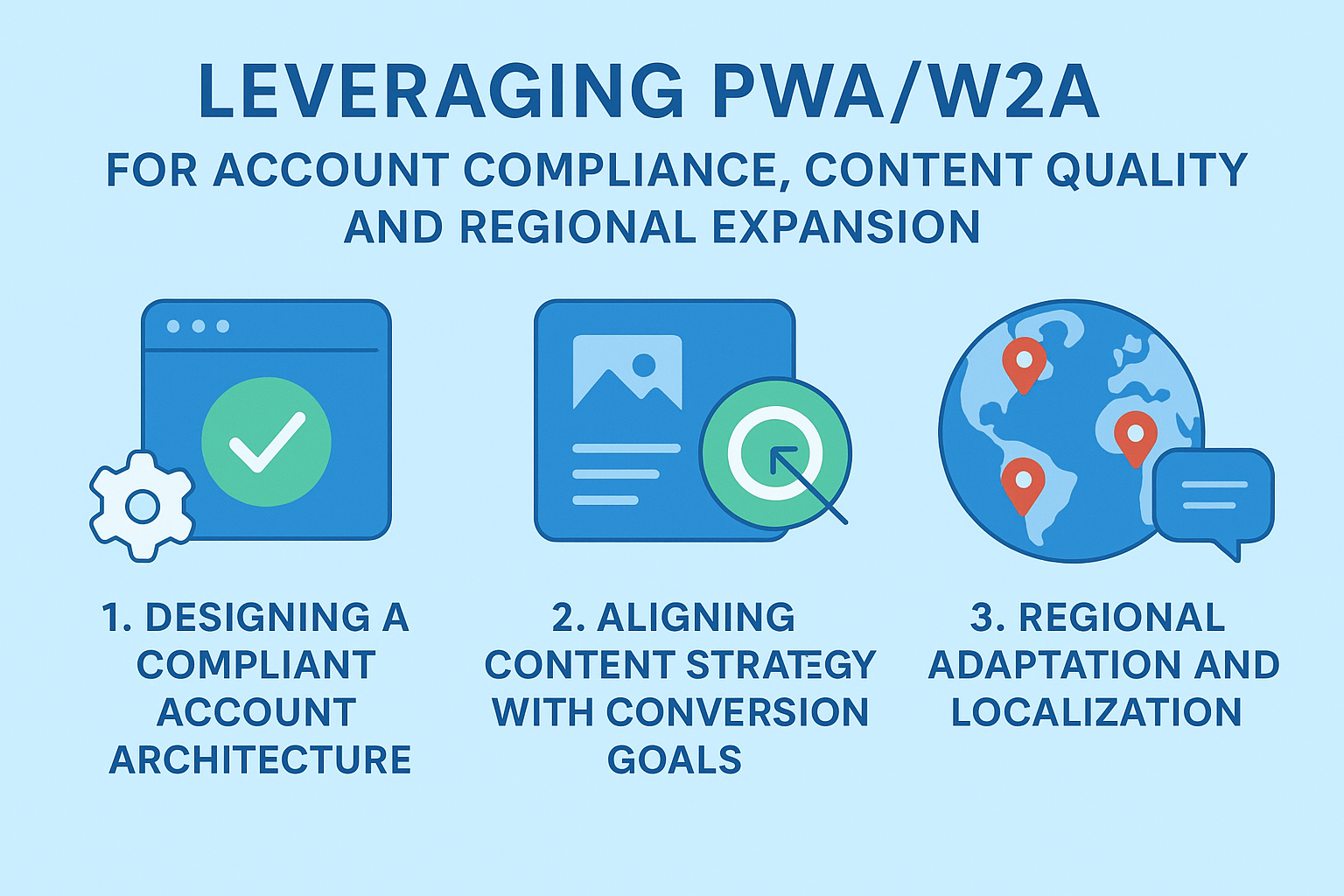
1. Designing a Compliant Account Architecture
Agencies can build structured account systems around PWA/W2A models:
● Redirect ad traffic to mid-layer web pages to reduce risk exposure from direct high-risk destinations.
● Deploy localized domains, privacy disclosures, and tracking scripts tailored to regional regulations.
● Use W2A bridge pages to enhance ad account trust scores and maintain stability.
2. Aligning Content Strategy with Conversion Goals
In PWA/W2A-based campaigns, content becomes the foundation of quality traffic , not just a creative asset.
● Differentiate between content-led and performance-led traffic.
● Create compliant ad creatives that sustain higher CTR and retention.
● Establish account-level and domain-level tracking consistency for transparent performance evaluation.
3. Regional Adaptation and Localization
Markets like Southeast Asia, LATAM, and MENA all have distinct advertising compliance landscapes. The PWA/W2A framework allows advertisers to validate different regions using low-risk web funnels before transitioning to full native apps.
Agencies can further assist with domain setup, privacy policy localization, and tracking configuration during the account onboarding stage.
Risks and Mitigation in the PWA / W2A Model
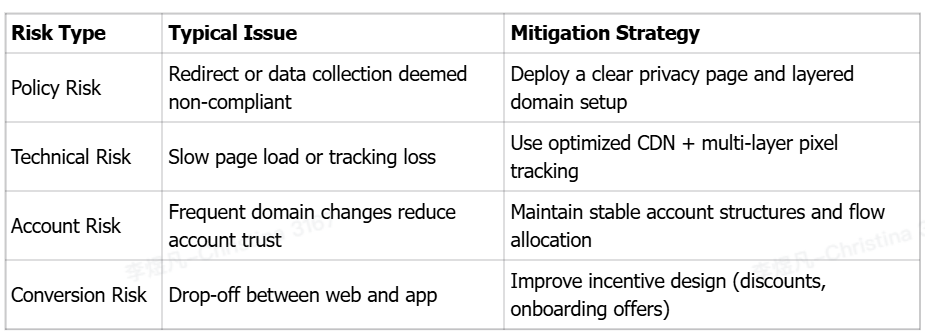
Every compliance model introduces new operational complexities. Below are the common risk factors agencies should monitor and how to mitigate them:
The Future: From "Alternative Setup" to Standard Practice
Over the next two years, PWA/W2A will evolve from workaround to core infrastructure in agency-level ad account management.
For performance marketing agencies and ad networks, early adoption means:
● Owning a replicable compliance framework
● Ensuring long-term account stability
● Delivering industry-specific solutions for sensitive categories
PWA/W2A represents more than a trend, it's the next infrastructure layer for compliant advertising in the post-privacy era.
Conclusion
By 2025, compliance will no longer be a constraint, it will be a competitive advantage. For brands and agencies aiming for sustainable growth, adopting PWA/W2A frameworks ensures both agility and security.
At Novabeyond, we help advertisers and agencies:
● Build compliant ad account structures
● Optimize tracking, creative testing, and campaign optimization
Whether you're navigating high-risk categories or optimizing cross-market campaigns, our compliance-based advertising systems ensure long-term, scalable, and sustainable growth.
more posts
Why TikTok Ads Live or Die by Creative and Meta Ads by Structure
June. 09 2026
LEARN MORE

Taboola and Native Traffic: Why Content-Contextual Advertising Is Your Next Performance Frontier
May. 27 2026
LEARN MORE

The June Marketing Playbook for Global E-commerce Brands
May. 22 2026
LEARN MORE

NewsBreak Ads Setup Guide: A Step-by-Step Tutorial for Launching Campaigns
April. 09 2026
LEARN MORE