





Copyright © 2026 NOVABEYOND LIMITED (company number 2833487). All rights reserved.
Address: UNIT 616 6/F KAM TEEM INDUSTRIAL BUILDING 135 CONNAUGHT ROAD WEST SAI WAN HONGKONG.
Why These Two Platforms Deserve More Attention
TikTok gets all the headlines, but it is far from the only short-video ad platform worth your budget. BIGO Ads and Kwai Ads have quietly built substantial user bases in markets where TikTok either faces restrictions, hasn't saturated the audience, or simply doesn't dominate. For performance marketers running global campaigns, ignoring these two platforms means leaving real volume on the table in some of the world's fastest-growing digital markets.
That said, the two platforms are not interchangeable. They serve different geographies, attract different user profiles, and reward different creative and category strategies. Understanding those differences is the starting point for spending on them intelligently.
Platform Backgrounds: A Quick Orienter
BIGO Ads is a programmatic advertising platform powered by BIGO TECHNOLOGY PTE. LTD., headquartered in China. Its ad inventory runs across two apps: Likee, a short-video platform, and imo, a messaging and calling app. BIGO Ads operates as a deep learning-based platform serving both user acquisition and app monetization for advertisers and developers globally.
Kwai Ads is the international advertising product of Kuaishou, one of China's two dominant short-video giants. Outside China, the app operates under the Kwai brand. Kuaishou's original DNA is rooted in content created by and for lower-tier cities and rural communities in China, and that same "authentic, everyday life" positioning has translated surprisingly well in certain international markets. Kwai's international growth has been deliberate and concentrated rather than spread thin.
Geographic Footprint: Where Each Platform Actually Has Users
This is the most important strategic question. Running ads on a platform where your target market isn't active is simply wasted budget.
BIGO Ads: U.S., Europe, Russia, and Emerging Markets in Asia
BIGO’s top traffic and monetization strength is concentrated across four core regions.
In the United States and Western Europe, BIGO maintains strong advertiser demand and high-value traffic, making these markets key drivers of revenue quality and monetization efficiency within its global footprint.
In Russia, BIGO has developed a particularly strong and resilient user base, where entertainment-driven short video and live streaming formats have seen sustained engagement.
In Southeast Asia, BIGO Ads has genuine depth in Indonesia, Vietnam, Thailand, and the Philippines. The platform gained early traction by aggressively localizing its product experience and benefiting from the region’s rapid mobile internet expansion and strong demand for short-video and social entertainment.
In the Middle East, BIGO has built a meaningful presence in markets such as Saudi Arabia, Egypt, and the UAE, where live streaming and social entertainment formats continue to scale.
In South Asia, India was historically one of BIGO’s most important markets before the 2020 ban on Chinese-affiliated apps. Pakistan and Bangladesh have partially filled that gap, although at a smaller overall scale.
Kwai Ads: Latin America, the Middle East, and Southeast Asia
Kwai's most remarkable story is Latin America, and specifically Brazil. Kwai became one of the most downloaded apps in Brazil by leaning into grassroots, working-class content that felt genuinely different from the more polished aesthetics of Instagram and early TikTok. It resonated with audiences in smaller cities and lower-income demographics who saw their own lives reflected on the platform. Brazil remains Kwai's single most important international market, with meaningful secondary penetration in Mexico, Colombia, and Argentina.
In the Middle East, Kwai competes directly with BIGO in markets like Saudi Arabia and Egypt, though with somewhat different user behavior and content formats.
Kwai also has a growing presence in Southeast Asia, though this market is more contested, particularly in Indonesia, where competition is intense. In Indonesia, Kwai operates under a separate brand, SnackVideo, which has built its own local recognition and user base.
Category Performance: What Sells on Each Platform
Geography determines where you can reach users. Category fit determines whether those users will actually respond to your ads.
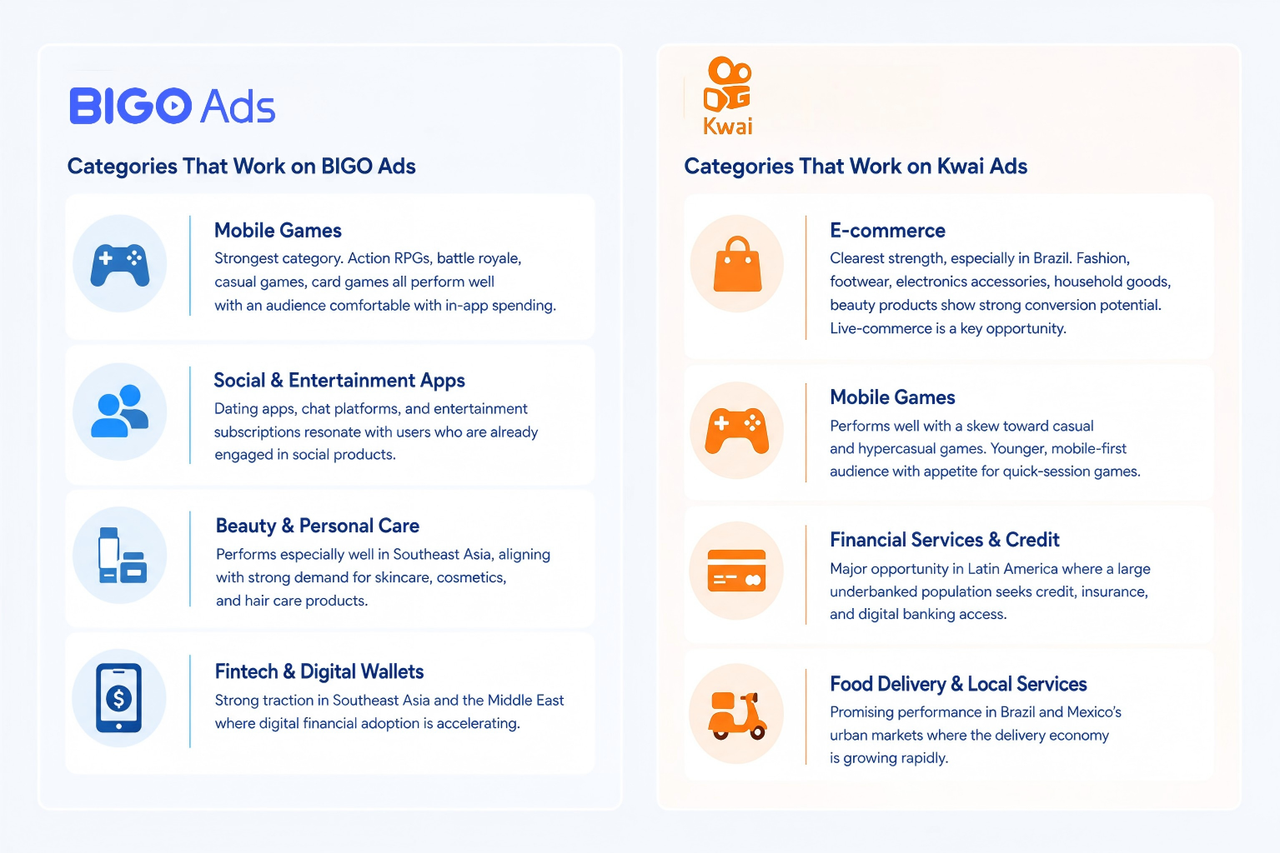
Categories That Work on BIGO Ads
Mobile games are the single strongest category on BIGO Ads, and this is not an accident. The platform's user base on Likee and imo already skews toward mobile-first audiences who spend on in-app items. Ads for action RPGs, battle royale titles, casual games with social mechanics, and card games all perform well. The audience's existing comfort with in-app spending lowers friction considerably.
Social and entertainment apps are a natural fit for a platform built on social entertainment. Dating apps, casual chat platforms, and entertainment subscriptions find receptive audiences who are already in the habit of downloading and engaging with social products.
Beauty and personal care performs strongly in Western markets, especially the U.S. and Europe, where a more mature female user base drives consistent demand for skincare, cosmetics, and hair care products.
Fintech and Financial services have found traction in markets where BIGO has strong penetration and digital financial infrastructure is still expanding, particularly in Western markets, especially the U.S. and Europe, as well as Russia.
Categories That Work on Kwai Ads
E-commerce is Kwai's clearest category strength, especially in Brazil. The platform's working-class user base in Latin America is an underserved e-commerce audience that is actively moving online. Categories like fashion, footwear, electronics accessories, household goods, and beauty products all show strong conversion potential. Brazil's growing enthusiasm for live-commerce makes this a particularly interesting environment for brands willing to experiment with that format.
Mobile games also perform on Kwai, with a skew toward casual and hypercasual titles rather than the hardcore genres that index more heavily on BIGO Ads. Kwai's Latin American audience is younger and mobile-first, with strong appetite for quick-session games.
Financial services and credit products have emerged as a significant category in Latin America, where a large portion of the adult population is underbanked and actively seeking credit, insurance, or digital banking access. Kwai's audience profile maps almost perfectly to the target demographic for challenger fintech brands in the region.
Food delivery and local services have shown promising performance in dense urban markets in Brazil and Mexico, where the delivery economy is growing rapidly and Kwai's mid-to-lower income audience is a core delivery customer segment.
Creative and Format Considerations
Both platforms are short-video environments, but the creative norms differ in ways that matter for production decisions.
On BIGO Ads, the ad inventory sits within Likee (short video) and imo (messaging), so the creative norms reflect those two environments. Short, punchy video content on Likee and more direct, utility-focused messaging on imo tend to outperform heavily produced brand advertising. Native-feeling formats consistently perform better than polished studio content on both apps.
On Kwai, particularly in Brazil, the winning creative style is warm, energetic, and community-oriented. Content that shows real people, reflects everyday situations, and uses humor or local cultural references consistently outperforms generic brand advertising. Over-produced creative often feels out of place and generates lower engagement. Portuguese language localization is non-negotiable in Brazil; Spanish is non-negotiable in the rest of Latin America.
In both cases, the first three seconds carry enormous weight. The platforms compete for attention against organic content, and users who are not immediately hooked will scroll. Testing multiple hook variants is as important here as it is on TikTok.
What This Means for Budget Allocation
Neither BIGO nor Kwai should be a primary channel for most global campaigns. They are best understood as complementary channels that solve specific geographic and audience problems.
Use BIGO Ads when you are targeting U.S., Europe, Russia, and Emerging Markets in Asia, and when your product is in mobile apps, nutra&e-com, leadgen offers. The platform's Likee and imo inventory gives access to short-video and messaging audiences with established mobile spending habits.
Use Kwai Ads when Latin America, particularly Brazil, is a meaningful part of your market. If your product serves a mass-market, value-conscious, or underbanked consumer, Kwai's audience is genuinely hard to reach as efficiently anywhere else. It is also worth testing in the Middle East as a complement to BIGO for short-video specific placements.
In both cases, start with a small test budget, localize your creative properly, and measure cost per acquisition against your benchmarks from larger platforms before scaling. Neither platform has the same volume ceiling as Meta or TikTok, but in the right markets and categories, they can deliver CPAs that are highly competitive.
Conclusion
The short-video advertising ecosystem is not monolithic. BIGO Ads and Kwai each occupy specific geographic and demographic niches that the larger platforms do not serve as well. BIGO Ads brings access to short-video and messaging audiences in Western markets, particularly the U.S. and Europe, as well as Russia. Kwai brings access to mass-market audiences in Latin America, where it has built a genuinely differentiated position.
The marketers who will capture the value here are those who treat these platforms as distinct strategic choices, invest in local creative, and resist the temptation to simply repurpose TikTok assets and hope for the same results. Platform fit, creative fit, and category fit all need to align. When they do, the efficiency gains are real.
more posts
Why TikTok Ads Live or Die by Creative and Meta Ads by Structure
June. 09 2026
LEARN MORE

Taboola and Native Traffic: Why Content-Contextual Advertising Is Your Next Performance Frontier
May. 27 2026
LEARN MORE

The June Marketing Playbook for Global E-commerce Brands
May. 22 2026
LEARN MORE
NewsBreak Ads Setup Guide: A Step-by-Step Tutorial for Launching Campaigns
April. 09 2026
LEARN MORE