





Copyright © 2026 NOVABEYOND LIMITED (company number 2833487). All rights reserved.
Address: UNIT 616 6/F KAM TEEM INDUSTRIAL BUILDING 135 CONNAUGHT ROAD WEST SAI WAN HONGKONG.
The digital advertising market is entering a new phase. AI is no longer valuable only because it improves bidding efficiency, automates optimization, or enhances audience targeting. It is now changing something even more fundamental: how traffic itself is distributed across the mobile ecosystem.
For years, many app advertisers assumed that competition happened mainly within their own category. Gaming companies competed with other games. E-commerce apps competed with marketplaces. Utility apps fought for low-cost installs, while entertainment products chased broad-reach traffic.
That assumption is rapidly becoming outdated.
Today, AI-driven advertising systems increasingly decide who wins impressions based on predicted engagement quality, conversion probability, retention signals, creative relevance, and campaign learning speed. In practical terms, this means gaming apps, short drama platforms, live commerce products, fintech services, utility tools, and subscription apps are now competing inside the same auction environments for users.
This is not a minor media buying update. It is a structural redistribution of traffic.
For app growth teams focused on user acquisition, that shift directly affects scale potential, CPM inflation, creative strategy, audience quality, and expansion opportunities.
From Category-Based Buying to Value-Based Acquisition
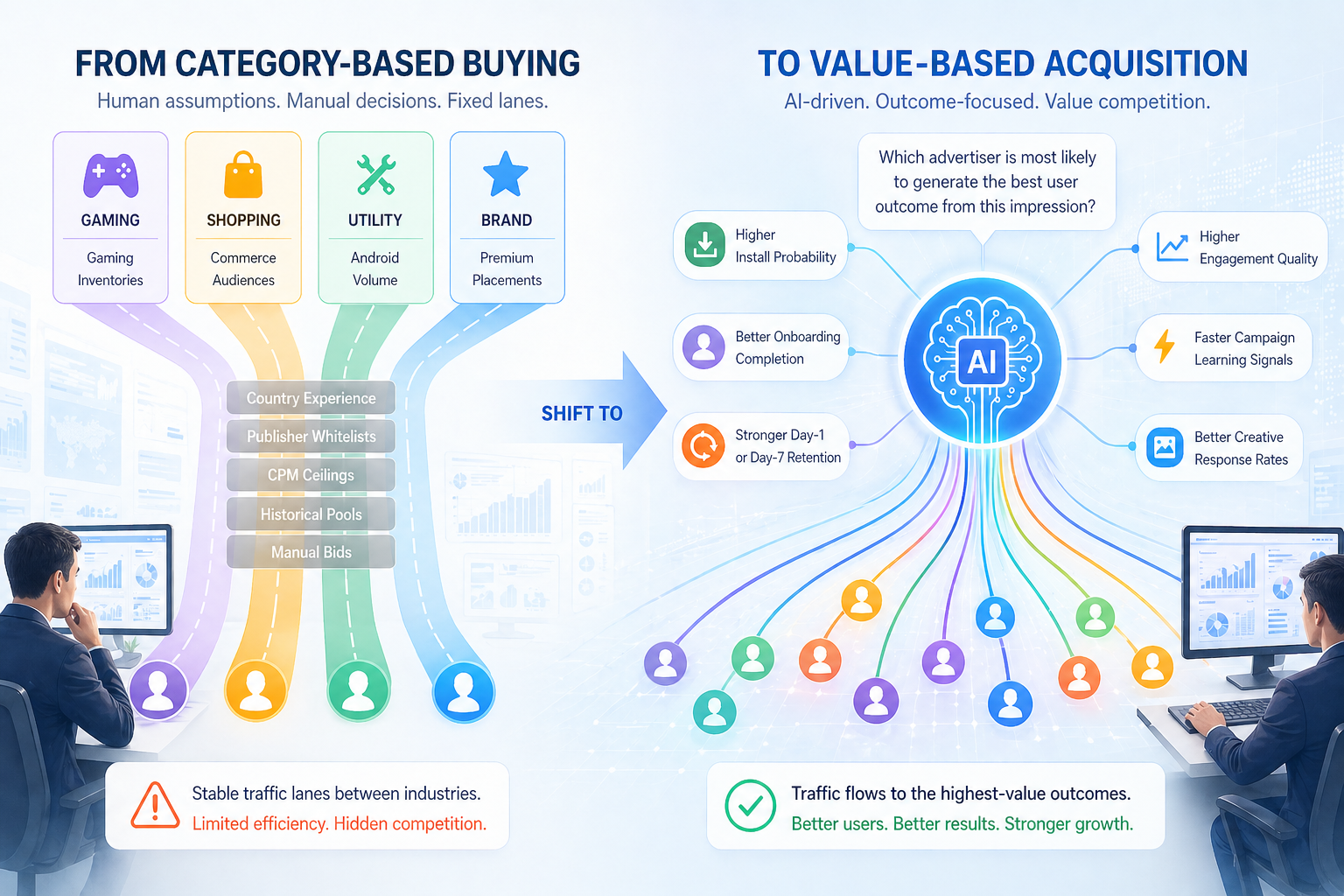
Traditional mobile advertising operated for years through category-based budget logic.
Gaming budgets often flowed toward gaming-friendly inventory. Shopping budgets pursued commerce-intent audiences. Utility apps focused on inexpensive Android volume, while brand advertisers manually secured premium placements.
The system was heavily driven by human assumptions. Media buyers relied on country experience, publisher whitelists, CPM ceilings, historical audience pools, and manual bid adjustments. Over time, this created relatively stable traffic lanes between industries.
AI systems do not think in lanes. Instead, they ask a different question:
Which advertiser is most likely to generate the best user outcome from this impression?
That outcome may include:
• Higher install probability
• Better onboarding completion
• Stronger Day-1 or Day-7 retention
• Higher engagement quality
• Faster campaign learning signals
• Better creative response rates
Once bidding systems optimize around that logic, traffic naturally moves away from lower-efficiency acquisition models and toward campaigns that produce stronger user signals.
This is why many advertisers feel rising costs without seeing obvious pressure from direct competitors. The real competition is often coming from outside their own category.
Why Gaming, Short Drama, and Live Commerce Matter Most
These three sectors are especially useful to study because they represent three different user acquisition models.
Gaming scales through immersive engagement and broad audience reach. Short drama scales through emotional hooks and fast user intent capture. Live commerce scales through urgency, creator influence, and action-driven traffic.
Each model is different, but all three are highly compatible with AI optimization systems. That is why they are among the clearest signals of where acquisition markets are heading.
Gaming Ads: Rich Signals Still Matter, but Privileged Access Is Fading
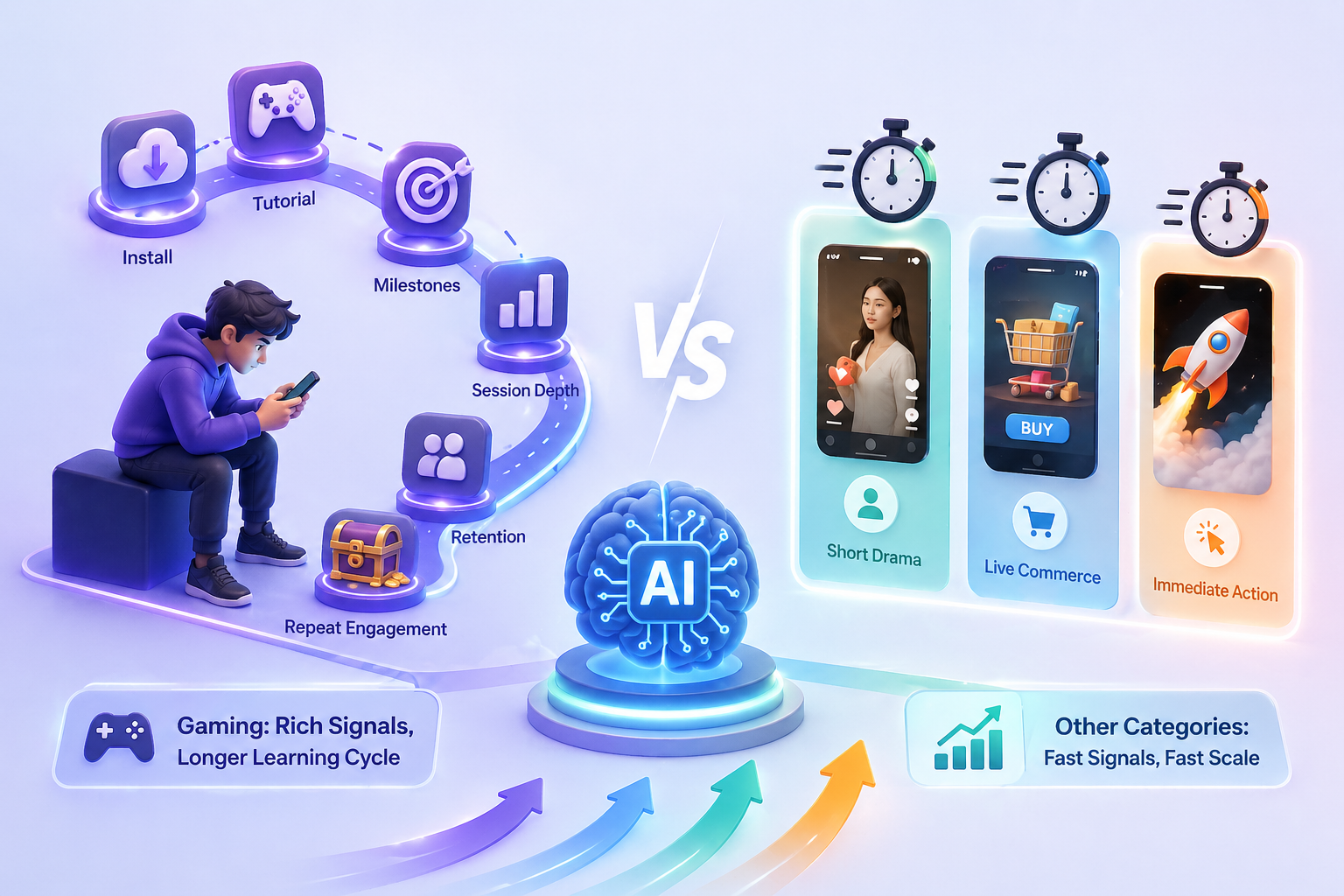
Gaming has long been one of the most advanced sectors in mobile advertising because it generates dense behavioral data.
A user journey often includes installs, tutorial completion, progression milestones, session depth, retention checkpoints, and repeated engagement. These events create ideal learning environments for algorithms.
For years, that gave gaming advertisers a natural advantage. AI systems could identify quality users, optimize toward valuable cohorts, and scale efficiently.
But the advantage is no longer automatic.
Many newer categories generate faster optimization signals. A game may require multiple sessions before quality can be measured. A short drama app may show engagement within the first session. A live commerce platform may trigger action immediately.
To AI systems, faster signals often mean faster learning cycles, stronger bidding confidence, and quicker scale.
That does not mean gaming is weakening. It means gaming must evolve.
Winning gaming advertisers now need:
• Predictive user quality models
• Stronger onboarding conversion
• Retention-based optimization
• Faster creative refresh cycles
• Regional audience segmentation
Gaming remains powerful, but it no longer owns premium traffic by default.
Short Drama Ads: Fast Feedback Is Changing Auction Dynamics
Short drama apps have become one of the fastest-growing acquisition categories in recent years, and they are one of the clearest examples of AI-era disruption.
Their core strength lies in compressing engagement into a short time window.
Users are often pulled in through emotionally charged creatives, enter highly engaging storylines, and respond quickly to cliffhangers or story hooks.
That means campaign signals arrive quickly.
In auction systems, speed matters. Campaigns that prove strong engagement in hours can often scale faster than campaigns that need days of user behavior before performance becomes clear.
This is one reason short drama products have absorbed inventory faster than many traditional entertainment apps expected.
They combine:
• High-click emotional creatives
• Fast first-session engagement
• Quick optimization feedback
• Nearly endless creative testing opportunities
However, the model also carries risk. Creative fatigue can happen rapidly, acquisition costs can rise quickly, and user churn can offset growth.
So short drama growth is not just about buying traffic cheaply. It is about operating a fast acquisition engine supported by constant creative renewal and strong retention systems.
Live Commerce Ads: Action-Oriented Traffic Gains Attention
If short drama is driven by emotional conversion, live commerce is driven by action-based conversion.
Its biggest advantage is that users can move from discovery to interaction quickly inside a single session. Host recommendations, limited-time offers, viewer participation, real-time product demos, and urgency-based messaging all help accelerate user action.
For AI systems, this is highly attractive because user intent is clear and measurable.
Unlike categories that optimize only for installs, live commerce advertisers often optimize toward deeper actions such as:
• Sign-ups
• Session engagement
• Add-to-cart behavior
• Return visits
• Repeat interactions
That allows stronger bidding logic and more efficient scaling.
This is one reason live commerce continues gaining momentum in Southeast Asia, LATAM, and parts of the Middle East, where mobile commerce behavior is evolving quickly.
For other app categories, the lesson is clear: markets increasingly reward advertisers who can prove stronger user intent, not just top-funnel traffic volume.
The Overlooked Effect: Cross-Category CPM Inflation
Many advertisers notice rising CPMs even when direct competitors appear stable.
The hidden reason is often cross-category competition.
A utility app may assume it competes only with other utilities. In reality, it may be losing bids to a fintech product with stronger retention signals, a short drama app with faster engagement feedback, a live commerce advertiser optimizing high-intent actions, or a game targeting premium users.
That means future cost pressure cannot be understood only through category benchmarks.
The real pricing force is which campaigns create stronger user signals per impression.
From that perspective, AI is not merely improving efficiency. It is repricing media inventory across the app economy.
Creative Production Is Being Rewritten at the Same Time
Traffic reallocation and creative transformation are happening together.
AI tools now allow advertisers to test more hooks, more languages, more formats, more audience angles, and faster iterations than ever before.
That matters because creative quality directly affects CTR, conversion rate, and auction win probability.
For categories like gaming and short drama, creative velocity can strongly influence scale velocity.
As a result, creative production is no longer just a design function. It is now part of acquisition infrastructure.
Many teams that lose traffic in the coming years will not lose because budgets are too small. They will lose because their creative systems are too slow.
What Programmatic App Teams Need to Do Now
For DSP buyers, agencies, and in-house growth teams, the next stage of competition will be defined less by intuition and more by operating systems.
Priorities should include:
• Moving beyond install KPIs toward quality-user metrics
• Shortening feedback loops for faster optimization
• Building continuous creative testing engines
• Reassessing geo mix and underpriced markets
• Measuring competition beyond your own category
Most importantly, advertisers must accept a new reality:
The company taking your traffic may not be in your category at all.
At Novabeyond, we help app advertisers operate in exactly this kind of market environment.
Across gaming, utility, fintech, e-commerce, and emerging verticals, the challenge is increasingly the same: build stronger acquisition signals, move faster through programmatic channels, scale creative testing efficiently, identify growth opportunities before pricing adjusts, and optimize toward real user growth outcomes.
As AI continues reallocating traffic, advertisers need more than buying power. They need partners who understand how traffic value is changing.
Final Thought
AI is not simply optimizing campaigns. It is deciding which acquisition models deserve traffic.
Gaming, short drama, and live commerce are not isolated trends. They are early signals of a broader market reset.
The old question was: How do we buy more traffic?
The new question is: Why should the system give traffic to us instead of someone else?
The advertisers who answer that question first will define the next era of app growth.
more posts
Middle East / Southeast Asia / LATAM: Regional Growth Differences & Strategy Guide for Mobile Apps
June. 08 2026
LEARN MORE

E-commerce Apps: A Full-Funnel Advertising Strategy from User Acquisition to Repurchase
June. 03 2026
LEARN MORE
From Generic Creative to Smart Matching: How DPB & DCO Drive Better ROAS
June. 02 2026
LEARN MORE
Why Most Apps Hit a 30-Day Growth Ceiling And How to Break It
April. 14 2026
LEARN MORE