




Copyright © 2026 NOVABEYOND LIMITED (company number 2833487). All rights reserved.
Address: UNIT 616 6/F KAM TEEM INDUSTRIAL BUILDING 135 CONNAUGHT ROAD WEST SAI WAN HONGKONG.
In an era defined by attention scarcity and content saturation, younger audiences are quietly shifting away from public-facing social performance toward communication that is more private, immediate, and creatively expressive. Snapchat’s continued growth is not an accident of trend cycles, it is the result of this deeper behavioral shift.
Snapchat is not a content distribution platform in the traditional sense. It is a communication infrastructure built around the camera, designed to support real relationships, real moments, and spontaneous self-expression. Where other platforms optimize for visibility and reach, Snapchat optimizes for presence and intimacy.
Since introducing ephemeral messaging in 2011, Snap Inc. has remained remarkably consistent in its “Camera First” product philosophy. Technology stays in the background, while human interaction remains at the forefront. This long-term strategic clarity has helped Snapchat cultivate a highly engaged, high-value user base, and has created a fundamentally different opportunity for brands seeking meaningful, not merely measurable, connections.
Platform Positioning: Built Around the Camera, Not the Feed
At its core, Snapchat operates more like a camera company than a social network. Nearly every user session begins with the camera, not a feed or a timeline.
This design choice defines the platform’s five core experience layers:
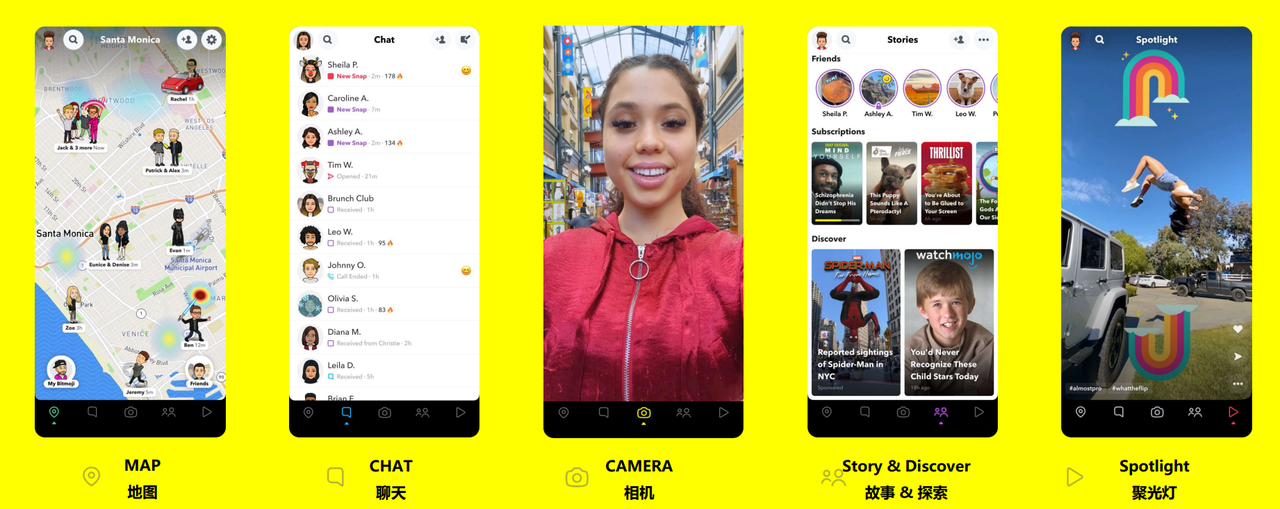
● Camera & AR, real-time lenses and augmented reality effects transform the camera into an interactive canvas
● Chat, visual-first conversations that blend text, voice, media, and lightweight utilities
● Stories, time-bound narratives that allow users to share moments without permanence or pressure
● Snap Map, a location-based social layer that connects friends, events, and local discovery
● Spotlight, a native short-form video environment designed to scale creator content without overt social pressure
AR is no longer a novelty feature, it is foundational. Over 200 million users engage with AR daily, and more than 5 billion Snaps are created each day, signaling not just adoption, but habitual use at scale.
User Scale and Behavioral Reality
Snapchat now reaches 750 million monthly active users globally, with 383 million daily active users, concentrated primarily in North America, Europe, and the Middle East.
Yet the most meaningful insight is not scale, it is usage behavior. Users open Snapchat more than 30 times per day on average and spend over 30 minutes daily on the platform. But unlike feed-driven apps, Snapchat is not something users scroll, it is something they use, to capture the moment, send a message, or stay close to people who matter.
This makes Snapchat a high-frequency, low-noise platform. It functions less like an entertainment channel and more like a digital layer embedded into daily life.
For advertisers, this fundamentally changes three things:
1. Users exhibit lower psychological resistance to brand messages
2. Ads are more naturally perceived as part of the experience
3. Brand impact tends to accumulate in memory, not just impressions
A Distinct Audience with Minimal Platform Overlap
In mature markets, Snapchat’s penetration among younger audiences is structurally unique.
● In the U.S., Snapchat reaches 90% of users aged 13–24, exceeding the combined reach of Facebook, Instagram, and Messenger in this cohort
● Among users aged 13–34, penetration stands at 75%
● Platform overlap is exceptionally low, many users open Snapchat daily while not engaging with other major social platforms at all
This low duplication makes Snapchat a powerful incremental channel, especially for brands struggling to find net-new reach through conventional social buys.
In high-potential non-English markets such as France, Canada, and Saudi Arabia, Snapchat reaches more than two-thirds of users aged 13–34, positioning it as a critical access point to next-generation consumers.
Brand Engagement Pathways: Native by Design
Snapchat’s advertising ecosystem is built to align with native user behavior rather than interrupt it.
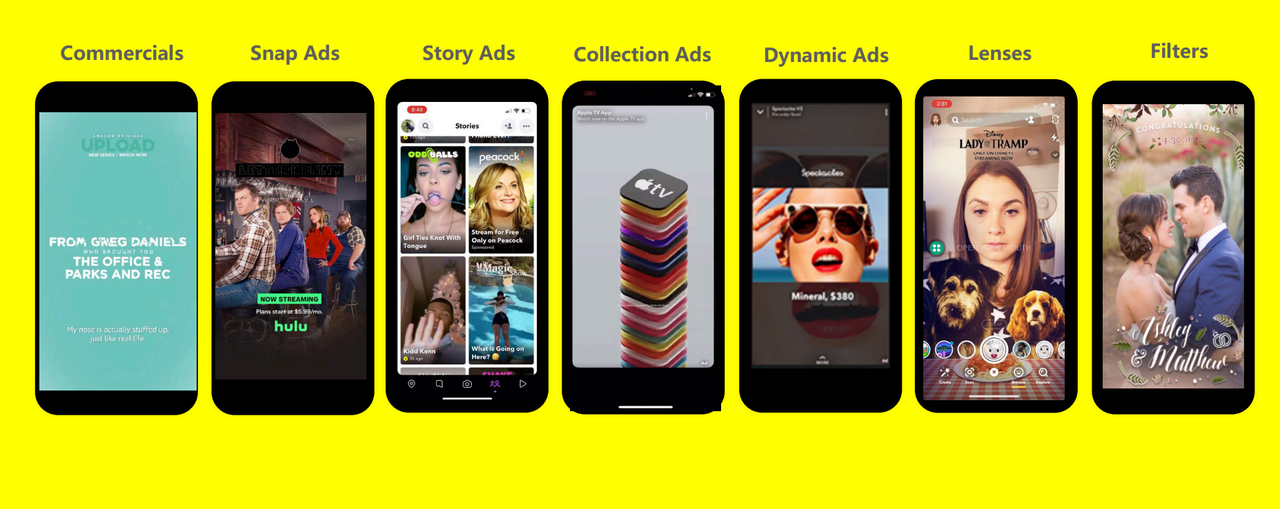
● Snap Ads and Story Ads, full-screen vertical video delivered seamlessly within content flows
● Collection Ads and Dynamic Product Ads (DPA), formats designed to support discovery-to-purchase journeys inside the platform
● AR Try-On Lenses, immersive experiences that allow users to virtually try cosmetics, apparel, footwear, or place furniture in real-world environments, then proceed directly to checkout. In practice, AR-driven shopping experiences have been shown to reduce return rates by up to 25%, while increasing purchase confidence
● Snap Pixel, cross-channel attribution capabilities, paired with Snap Audience Network (SAN), which extends reach into premium third-party apps without sacrificing performance efficiency
● Brand Profiles, long-term brand destinations that combine public stories, subscriptions, highlights, local store integration, and branded lenses into durable brand assets
As a result, Snapchat consistently delivers strong performance for industries such as fashion, beauty, skincare, footwear, accessories, consumer electronics, and lifestyle products.
Snapchat’s growth is not driven by algorithmic tricks or short-term content booms. It is rooted in a simple but difficult question: how do people actually want to connect?
By meeting users before they become desensitized to advertising, and by embedding brands into moments of genuine expression, Snapchat offers something increasingly rare in digital marketing, relevance without intrusion. For brands looking to move beyond exposure and toward real presence in everyday life, Snapchat is not an alternative channel. It is a fundamentally different one.
more posts
MediaGo, Taboola, and Outbrain: How Native Ad Platforms Differ for E-commerce Brands
June. 22 2026
LEARN MORE

BIGO Ads vs Kwai Ads: How Geography and Category Shape Performance in Short-Video Ecosystems
June. 16 2026
LEARN MORE
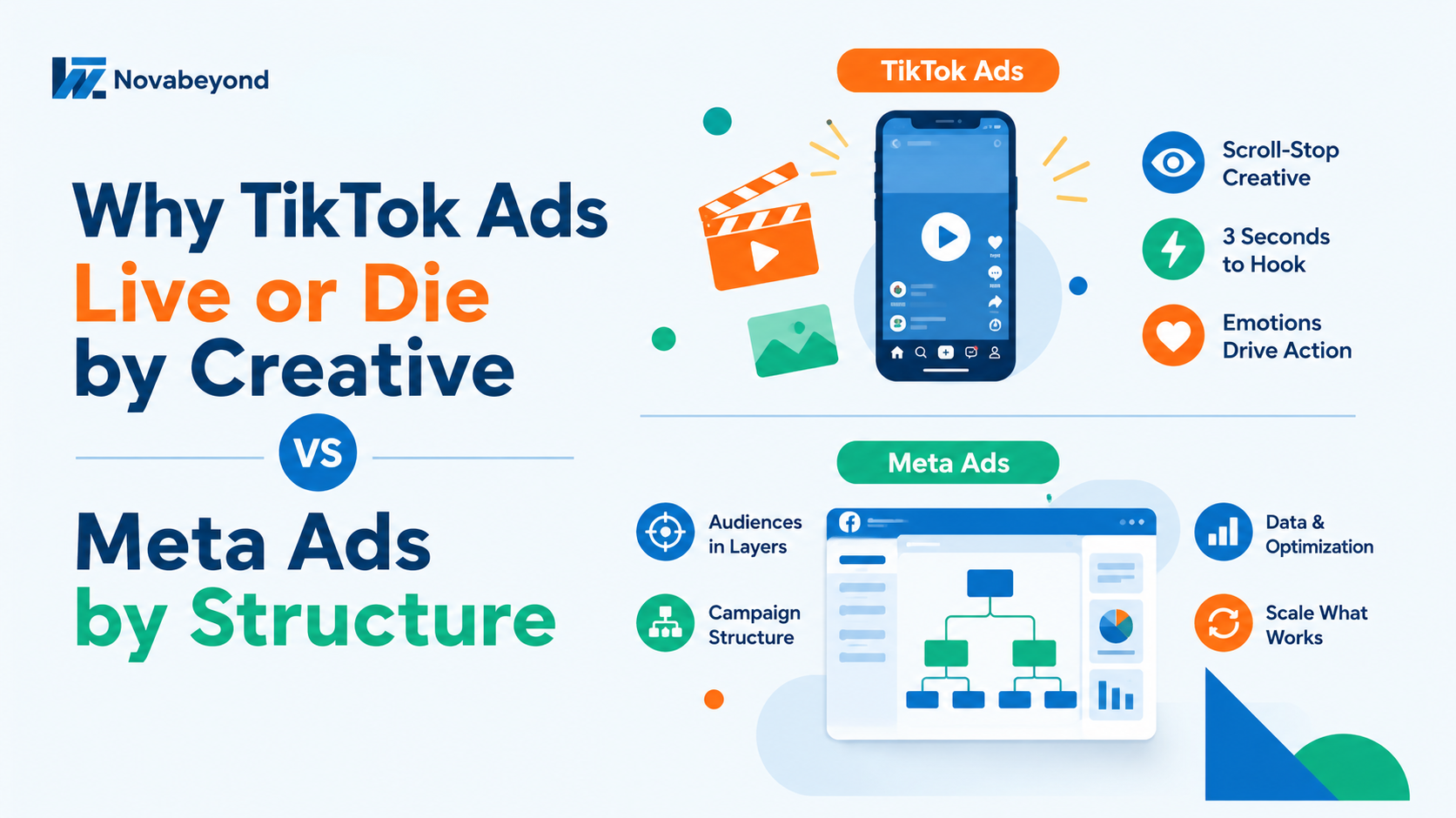
Why TikTok Ads Live or Die by Creative and Meta Ads by Structure
June. 09 2026
LEARN MORE
Taboola and Native Traffic: Why Content-Contextual Advertising Is Your Next Performance Frontier
May. 27 2026
LEARN MORE