






Copyright © 2026 NOVABEYOND LIMITED (company number 2833487). All rights reserved.
Address: UNIT 616 6/F KAM TEEM INDUSTRIAL BUILDING 135 CONNAUGHT ROAD WEST SAI WAN HONGKONG.
Launching a new app is never just about going live in the app store. The real challenge begins after launch. when you need traffic, installs, and engagement, but the algorithm doesn’t yet understand who your users are, what converts, or why your app deserves scale.
This is the cold start phase. And for most new apps, it’s where growth either accelerates, or quietly stalls.
At Novabeyond, we’ve worked with apps across finance, e-commerce, utilities, and content platforms, and one pattern appears again and again: successful cold starts are not about pushing volume early, but about feeding the right signals to the algorithm, in the right order.
This guide breaks down how to do exactly that.
Why App Cold Start Is an Algorithm Problem (Not a Traffic Problem)
The core of a Programmatic Advertising platform is itself an algorithmic learning system.
For a brand-new app, the algorithm starts with:
• No historical conversion data
• No user behavior patterns
• No clarity on high-quality users
If you push aggressive scale too early, the system compensates by:
• Expanding targeting blindly
• Optimizing toward low-quality installs
• Misreading early engagement signals
The result? High CPI volatility, unstable performance, and poor downstream metrics.
A strong cold start strategy is about teaching the algorithm how to win, not forcing it to spend.
Step 1: Define the first “meaningful signal”
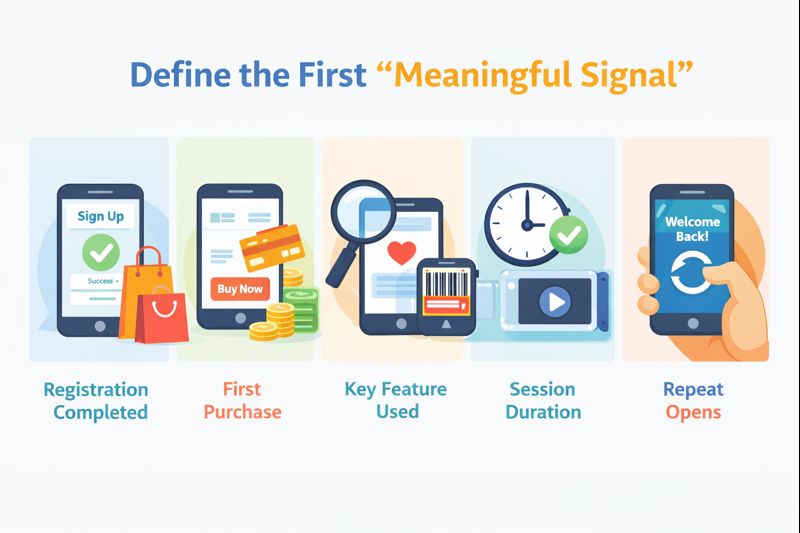
One of the most common cold start mistakes is optimizing for the wrong early goal. Installs alone are rarely enough. Instead, you need to decide:
• What is the first action that indicates real user intent?
• What behavior best predicts long-term value?
Depending on the app, this could be:
• Registration completed
• First transaction initiated
• Key feature used (search, save, scan, match, etc.)
• Session duration or repeat open
At Novabeyond, we often help teams delay deep funnel optimization and instead focus on a single, clean, high-signal event that the algorithm can learn from quickly.
Clarity beats complexity at this stage.
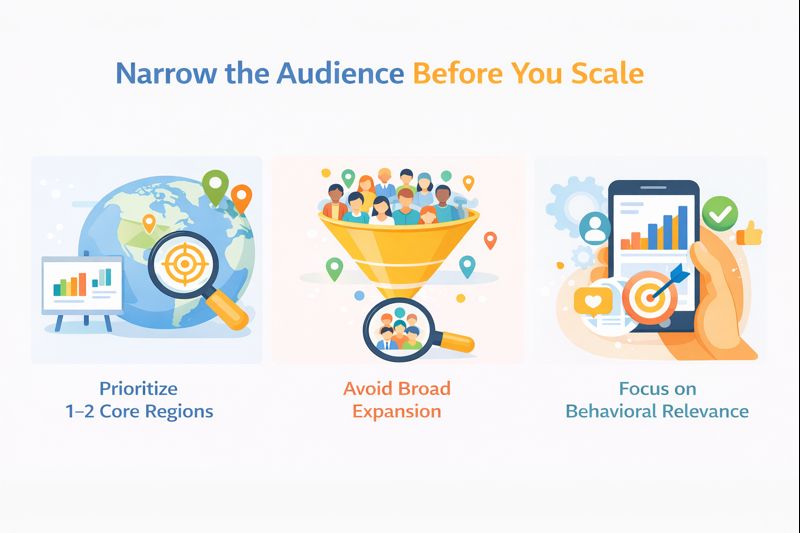
Step 2: Narrow the audience before you scale it
Algorithms learn faster from concentrated data, not broad guesses.
In the early phase, that means:
• Avoiding overly wide geo or interest expansion
• Prioritizing 1–2 core regions
• Starting with audiences that already show behavioral relevance
This is especially critical for programmatic and performance social platforms, where early noise can permanently bias learning.
Cold start targeting should feel slightly “too tight” at first. Scale comes later, after the algorithm understands what success looks like.
Step 3: Creative is not decoration, it’s data
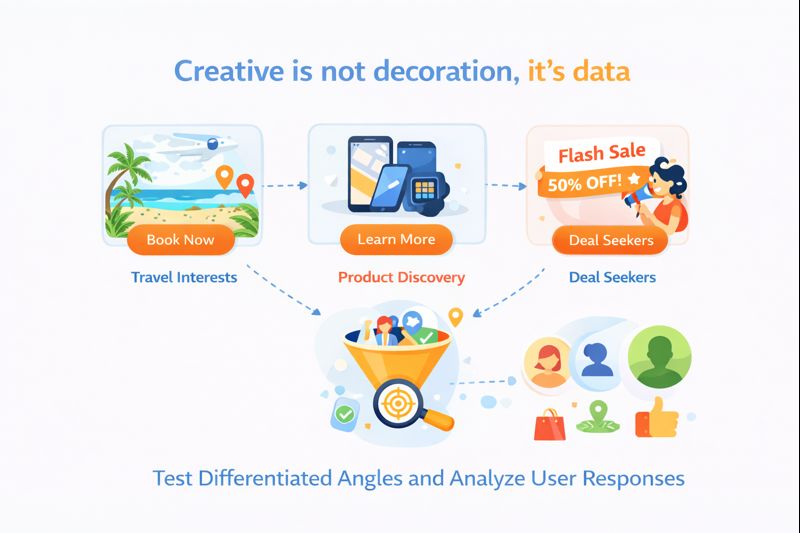
During cold start, creatives are not just messages. They are data inputs.
Every visual, hook, and call-to-action teaches the algorithm:
• Who responds
• In what context
• With what intent
Instead of launching dozens of variations, we recommend:
• A small set of clearly differentiated creative angles
• Each angle mapped to a specific user motivation
• Consistent messaging within each test group
This allows platforms to cluster responses faster and identify patterns earlier. Random variety slows learning. Structured testing accelerates it.
Step 4: Control budget to protect learning stability
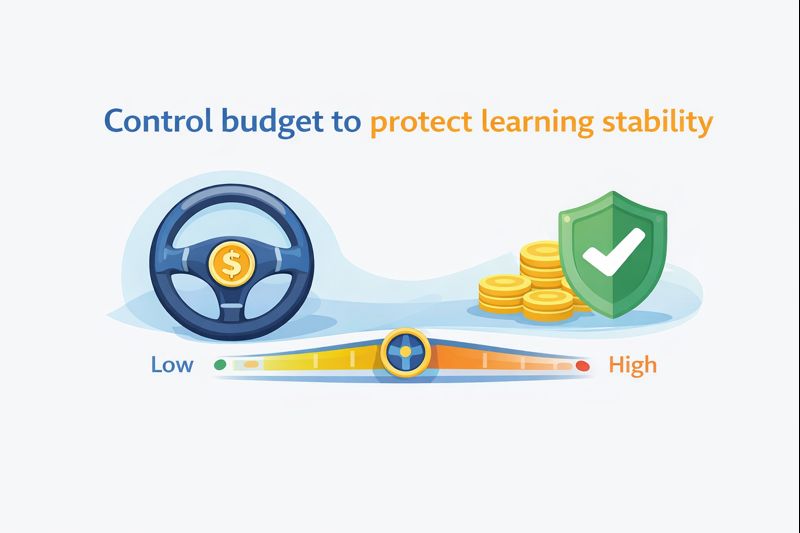
More budget does not equal faster learning. In fact, unstable budgets are one of the fastest ways to reset algorithm progress.
Best practices we apply during cold start:
• Gradual budget increases (not sudden jumps)
• Stable daily spend windows
• Enough volume per ad group to reach learning thresholds
The goal is to keep the algorithm calm, predictable, and confident in its optimization path.
Think of budget as a steering wheel, not a gas pedal.
Step 5: Measure what the algorithm can’t see
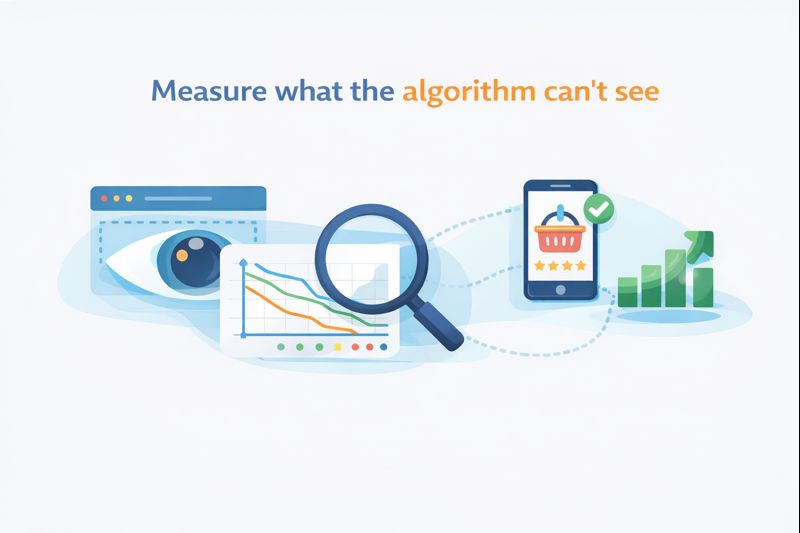
Platforms optimize based on what they can track, but your real success metrics often live beyond that. This is where many cold starts fail silently.
We advise teams to monitor:
• Retention cohorts by source
• Event drop-off patterns
• Post-install behavior quality
• Early LTV proxies
At Novabeyond, we regularly see campaigns with “good CPI” hide serious quality issues that only surface weeks later. Cold start success is not about winning today’s dashboard, it’s about setting up tomorrow’s scalability.
What a Successful Cold Start Actually Looks Like
A healthy cold start does not look explosive. It looks like:
• Stable CPIs
• Clear behavioral signals
• Gradual improvement, not spikes
• Confidence in who the real users are
When the algorithm understands your app, scaling becomes a strategy discussion, not a gamble.
Final Thoughts: Cold Start Is a Foundation, Not a Phase
Cold start is often treated as a short, painful stage to rush through. In reality, it’s the foundation that determines whether growth compounds or collapses.
The teams that win are not the ones who spend fastest, but the ones who:
• Respect how algorithms learn
• Design signals intentionally
• Align creatives, audiences, and measurement from day one
At Novabeyond, we don’t see cold start as a hurdle. We see it as the moment where long-term performance is quietly decided.
If you get this part right, everything that follows becomes easier.
more posts
AI’s Impact on Gaming, Short Drama, and Live Commerce Advertising: Why Traffic Reallocation Is Reshaping App Growth
June. 15 2026
LEARN MORE

Middle East / Southeast Asia / LATAM: Regional Growth Differences & Strategy Guide for Mobile Apps
June. 08 2026
LEARN MORE
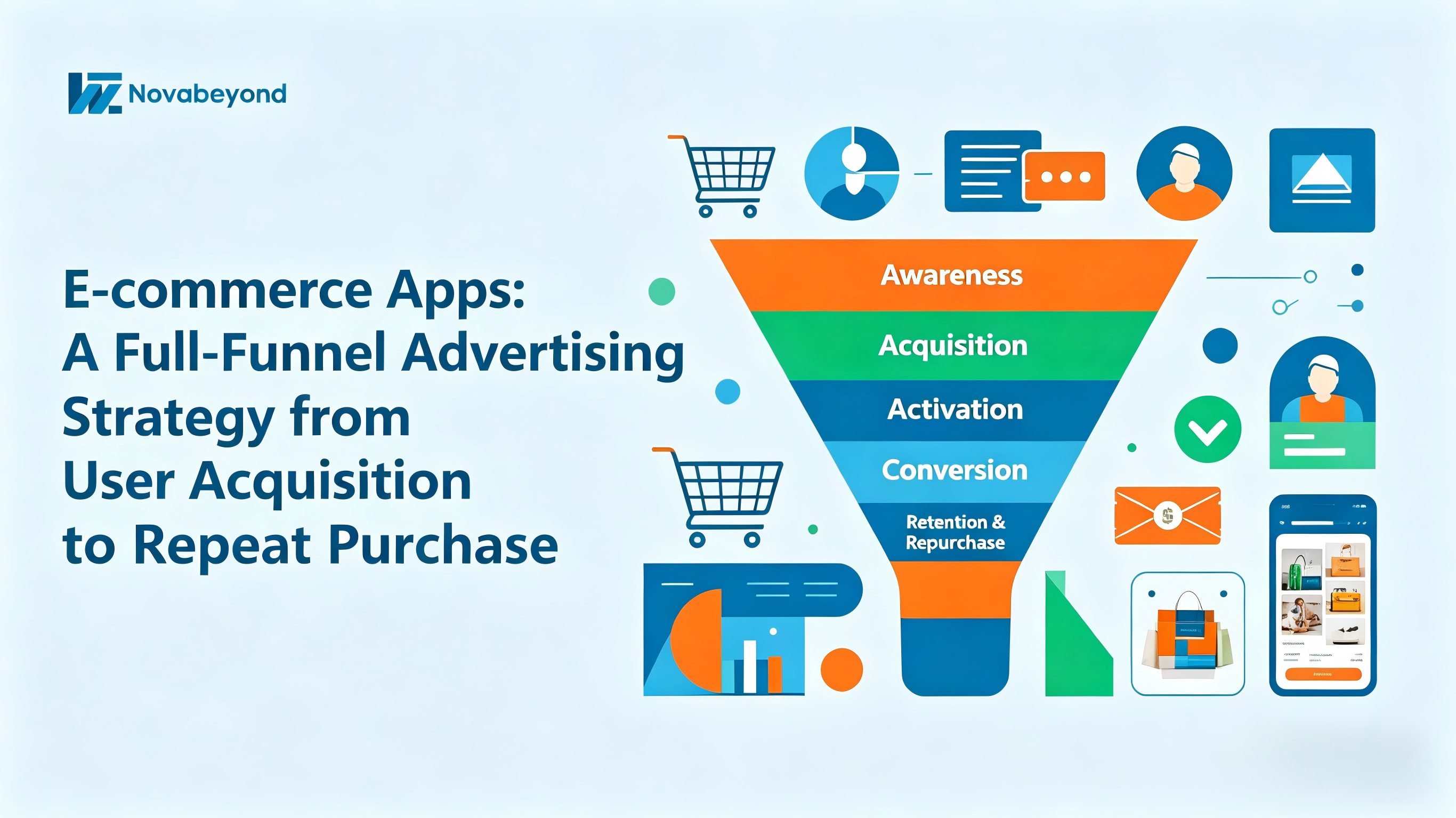
E-commerce Apps: A Full-Funnel Advertising Strategy from User Acquisition to Repurchase
June. 03 2026
LEARN MORE
From Generic Creative to Smart Matching: How DPB & DCO Drive Better ROAS
June. 02 2026
LEARN MORE