





Copyright © 2026 NOVABEYOND LIMITED (company number 2833487). All rights reserved.
Address: UNIT 616 6/F KAM TEEM INDUSTRIAL BUILDING 135 CONNAUGHT ROAD WEST SAI WAN HONGKONG.
Connected TV (CTV) is no longer an emerging channel, it is rapidly becoming one of the most structurally important environments in digital advertising. As streaming consumption replaces linear viewing habits, CTV sits at the intersection of television-scale reach and digital-grade addressability.
What is driving this transformation is not CTV inventory alone, but the rise of programmatic buying as the dominant operating model for CTV advertising.
This shift marks a fundamental change in how video media is planned, activated, and evaluated.
CTV’s Growth Is Structural, Not Cyclical
The expansion of CTV is often framed as a response to cord-cutting or changing viewing behavior. While these trends are real, they only explain part of the story.

The deeper shift is that television has moved from:
• Fixed schedules to on-demand consumption
• Channel-based buying to audience-based buying
• Forecasted impressions to predictable delivery
CTV is no longer bound by broadcast logic. It operates within digital infrastructure, making programmatic buying not just compatible, but essential.
Why CTV Naturally Evolves Toward Programmatic Buying
CTV inventory lives across a fragmented ecosystem: streaming apps, smart TV operating systems, OEM environments, and hybrid OTT platforms. Managing this complexity through traditional buying methods quickly reaches its limits.
Programmatic buying addresses this reality in three critical ways.
1. Aggregation Across Fragmented Supply
Programmatic platforms consolidate CTV inventory across multiple publishers and environments, enabling advertisers to access scale without negotiating each supply source individually.
This aggregation is not just operational efficiency, it is the foundation of scalable reach in a highly distributed media landscape.
2. Audience-Centric Activation
Unlike linear TV, programmatic CTV allows campaigns to be planned around audiences rather than programs. Activation can be driven by:
• Household-level data
• Interest and behavioral signals
• Cross-device exposure logic
This makes CTV part of the broader addressable media ecosystem, rather than a standalone video channel.
3. Dynamic Control and Optimization
Programmatic execution introduces pacing, frequency management, and delivery optimization that simply do not exist in traditional TV buying.
As a result, CTV shifts from a “set-and-forget” medium to a controllable, adaptive channel.
Redefining the Role of CTV in the Media Mix
One of the most common mistakes advertisers make is positioning CTV as either: A direct replacement for linear TV, or A pure branding channel with limited accountability
In practice, programmatic CTV performs best when it is viewed as a mid-to-upper funnel accelerator that influences outcomes across the entire media system.
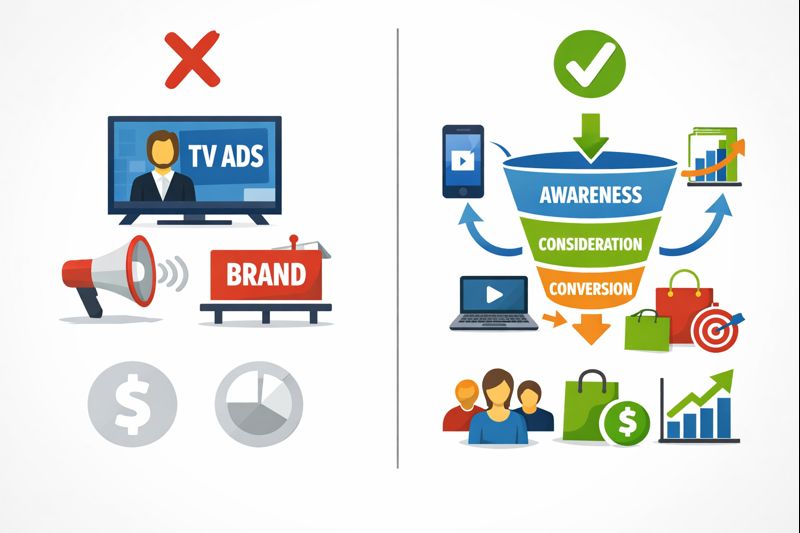
Rather than driving immediate conversions, CTV often:
• Expands high-quality reach beyond saturated mobile inventory
• Improves downstream conversion efficiency
• Stabilizes performance volatility in lower-funnel channels
Its value lies in exposure quality and attention context, not last-click attribution.
Where Programmatic CTV Strategies Often Fail
Despite strong momentum, many CTV campaigns underperform, not because of inventory limitations, but due to strategic misalignment.
Common issues include:
• Optimizing solely for CPM instead of attention and exposure consistency
• Running CTV in isolation from other programmatic channels
• Poor frequency coordination across devices
• Limited post-view or incremental impact analysis
These challenges highlight a key reality: programmatic CTV is a system challenge, not a placement challenge
Programmatic CTV as Part of a Cross-Screen System
The true strength of programmatic CTV emerges when it is designed as part of a unified, cross-screen strategy.
Within a mature programmatic framework, CTV can:
• Serve as the primary reach and attention layer
• Feed exposure signals into mobile and in-app environments
• Support sequential messaging and retargeting logic
This system-level approach transforms CTV from a visibility channel into a structural growth lever.
Market Maturity: From Access to Execution Quality
As CTV inventory continues to expand globally, simple access is no longer a differentiator. The next phase of market maturity will be defined by:
• Smarter role definition within the funnel
• Better frequency and exposure management
• More sophisticated measurement of incremental value
Advertisers who succeed in programmatic CTV will not be those who spend more, but those who execute with clearer intent and stronger integration.
Final Thoughts
From our experience observing and supporting programmatic media strategies across multiple markets, the most effective CTV campaigns share a common trait: they are designed with restraint, clarity, and system awareness.
At Novabeyond, we view programmatic CTV not as a standalone solution, but as a strategic layer within a broader programmatic ecosystem, one that rewards long-term thinking over short-term metrics.
The explosion of CTV advertising is not driven by novelty, but by alignment. CTV aligns with how people consume content, and programmatic aligns with how modern media must be operated.
As these two forces converge, programmatic CTV is becoming one of the most important building blocks in digital advertising. Not because it is new, but because it finally makes television work like modern media.
more posts

AI’s Impact on Gaming, Short Drama, and Live Commerce Advertising: Why Traffic Reallocation Is Reshaping App Growth
June. 15 2026
LEARN MORE


Middle East / Southeast Asia / LATAM: Regional Growth Differences & Strategy Guide for Mobile Apps
June. 08 2026
LEARN MORE

E-commerce Apps: A Full-Funnel Advertising Strategy from User Acquisition to Repurchase
June. 03 2026
LEARN MORE

From Generic Creative to Smart Matching: How DPB & DCO Drive Better ROAS
June. 02 2026
LEARN MORE