





Copyright © 2026 NOVABEYOND LIMITED (company number 2833487). All rights reserved.
Address: UNIT 616 6/F KAM TEEM INDUSTRIAL BUILDING 135 CONNAUGHT ROAD WEST SAI WAN HONGKONG.
Utility apps have always occupied a difficult position in the app economy. They are highly functional, often essential, yet rarely memorable. Users install them with a clear goal, complete a task, and move on. The value exchange is efficient, but short-lived.
For years, this model worked. Acquisition was affordable, platforms rewarded scale, and monetization could rely on high install volume and short-term conversion.
That model is now breaking down.
In 2026, rising user acquisition costs, subscription-first monetization, and stricter platform quality signals are forcing utility apps to confront a fundamental question: how do we increase lifetime value in a product designed for short-term use?
The answer is not more aggressive paywalls or heavier discounts. It requires a deeper shift in how utility apps define value, engagement, and user relationships, and how those ideas are translated into product decisions.
Why Utility Apps Struggle With LTV by Default
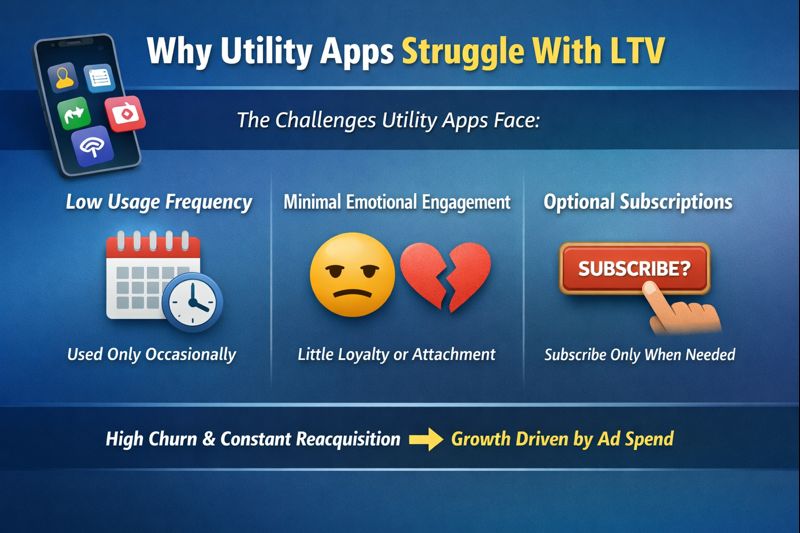
Low LTV is not a failure of execution for most utility apps; it is a predictable outcome of their core design.
Most utility products are built around single-scenario intent. A user needs to clean storage, convert a file, scan a document, or unblock content. Once that task is complete, the app has fulfilled its purpose. There is no natural habit loop, no ongoing discovery, and no emotional attachment.
This creates three structural limitations that show up clearly in real product data.
• First, usage frequency is inherently low. Even highly satisfied users may only return once every few weeks. This limits how often value can be reinforced and how often monetization messages can appear without feeling intrusive.
• Second, emotional engagement is minimal. Utility apps are rational tools, not identity-driven products. Users appreciate them, but rarely feel loyal to them. This makes churn decisions easy and switching costs low.
• Third, subscriptions feel optional rather than essential. Many users think, “I’ll subscribe when I need it,” instead of “I need this running all the time.” No matter how optimized the funnel is, that mindset places a ceiling on LTV.
As a result, many utility apps end up stuck in a cycle of high churn and constant reacquisition, where growth depends more on media spend than on product value accumulation.
The Fundamental LTV Shift: From Tasks to Outcomes
Utility apps that successfully increase LTV make one critical shift: they stop selling features and start selling continuity. Instead of positioning themselves as tools that solve isolated problems, they present themselves as systems that deliver ongoing outcomes. This reframes the user relationship from reactive to proactive.
In practice, this shift often shows up in three concrete ways:
• One-time actions are reframed as long-term protection, efficiency, or reliability
• Feature value is bundled into ongoing states, such as “always optimized” or “always protected”
• Monetization moves from “pay to complete this task” to “subscribe to avoid future friction”
When users perceive value as something that accumulates over time rather than something consumed instantly, subscriptions feel more natural. Conversion becomes less about urgency, and churn decreases because value does not reset after a single use.
Redefining the Core Value Narrative (and Making It Stick)
Before product mechanics or pricing models change, LTV growth often starts with messaging, but messaging only works if it is reinforced by real product behavior.
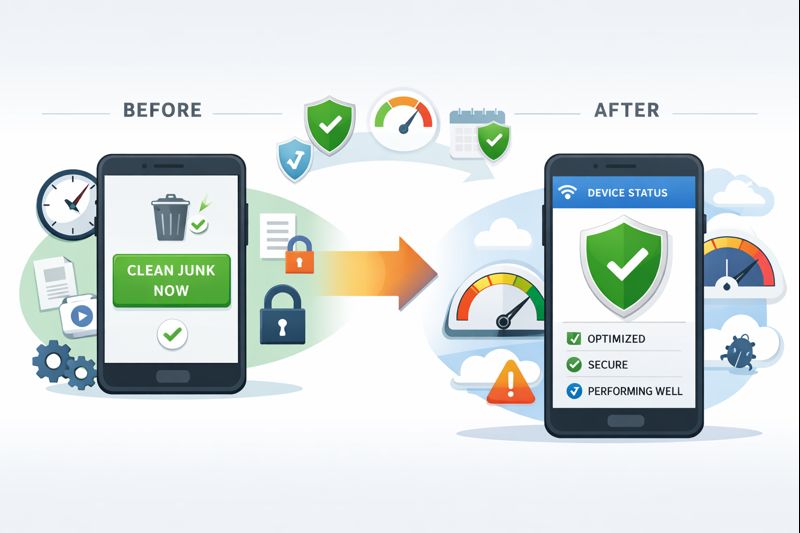
Low-LTV positioning focuses on immediate actions: clean files, convert formats, unlock access. High-LTV positioning focuses on the state users want to maintain.
For example, a cleaner app that promises “one-tap junk removal” is selling an action. An app that promises “keep your phone fast and secure every day” is selling peace of mind. The feature may be identical, but the value horizon is very different.
To make this shift tangible, high-LTV apps usually do at least one of the following:
• Visually show ongoing status, such as system health, protection level, or performance stability
• Reinforce value through language like “since last scan,” “currently protected,” or “running in the background”
• Tie individual actions back to a broader outcome, instead of letting them feel isolated
Similarly, many successful utility apps shift from action-based messaging to risk-based or prevention-based narratives. Rather than emphasizing what users can do now, they emphasize what users can avoid later, slowdowns, security risks, repeated manual work, or workflow interruptions.
This change is subtle, but it directly influences whether users see the product as disposable or indispensable.
Building Reasons to Return Without Forcing Usage
One of the hardest problems in utility app retention is creating return behavior without artificial engagement.
High-performing products do not force daily usage where it doesn’t make sense. Instead, they design justified return moments that remind users of ongoing value.
Common patterns that work in practice include:
• Background or passive functionality, where value continues even when the app is not actively used
• Periodic summaries or health checks that show what has been maintained, improved, or prevented
• Scenario expansion, where the app solves adjacent problems instead of repeating the same task
The key is relevance. Users should feel that returning to the app either saves future effort or prevents future issues, not that they are being pulled back to inflate engagement metrics.
When return behavior is tied to reassurance rather than obligation, retention becomes more stable and less fragile.
Making Subscription Feel Like Insurance, Not a Toll Gate
One of the most common monetization mistakes in utility apps is framing subscription as a barrier rather than a benefit.
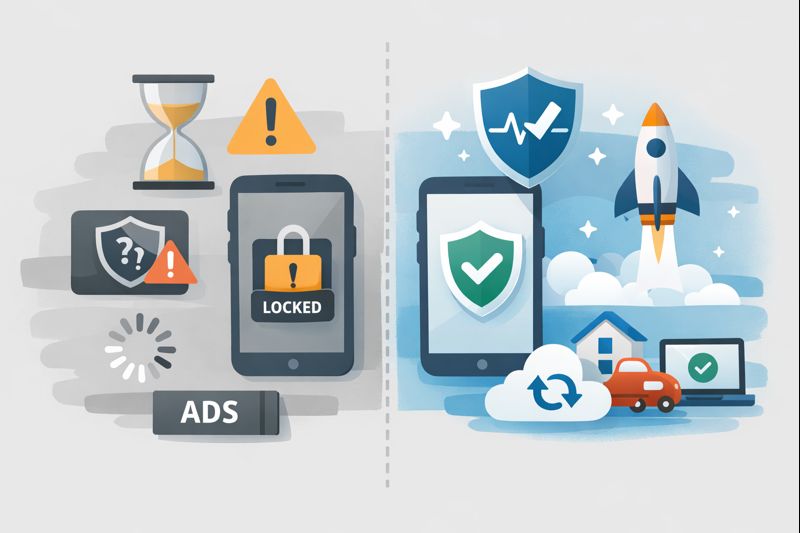
When users hit a paywall immediately after completing a task, the subscription feels like a toll: pay to finish what you started. This can drive short-term conversion, but it often results in fast churn and low lifetime value.
Higher-LTV apps frame subscription as insurance. Users are not paying to unlock a single feature; they are paying to ensure continuity, stability, and peace of mind over time. This framing is often reinforced through product details such as:
• Ongoing protection or monitoring rather than one-time actions
• Priority processing, automation, or background optimization
• Seamless access across multiple scenarios without repeated friction
Free users still receive value, but they experience small, repeated limitations that make the subscription feel reasonable rather than coercive. Over time, upgrading feels like a rational decision, not a forced one.
Aligning User Acquisition With LTV Reality
LTV optimization does not stop at the product level. Acquisition strategy plays a decisive role.
Many utility apps still acquire users based purely on the lowest possible CPA, regardless of intent depth. This floods the product with users who want a quick fix and have no interest in long-term value.
As ad platforms increasingly optimize for post-install behavior and revenue signals, this approach becomes risky.
High-LTV utility apps align acquisition messaging with their long-term value proposition. They attract users who are looking for reliability, protection, or ongoing efficiency, not just a one-time solution.
In practice, this often means accepting slightly higher CPAs in exchange for users who convert later, churn less, and generate meaningfully higher lifetime revenue. Over time, this alignment stabilizes growth and reduces dependency on constant reacquisition.
LTV Is a Product Strategy, Not a Monetization Trick
The most important lesson is this: LTV cannot be optimized at the end of the funnel.
No pricing experiment, onboarding tweak, or discount strategy can compensate for a product users fundamentally do not need to keep. Sustainable LTV growth requires rethinking the role the utility app plays over time.
When a utility app evolves from a disposable tool into a trusted system, something users rely on quietly and continuously, subscriptions stop feeling like a hard sell. They become a logical extension of value.
In a market where traffic is expensive and churn is unforgiving, this shift is no longer optional. It is the difference between scaling efficiently and constantly starting over.
more posts
AI’s Impact on Gaming, Short Drama, and Live Commerce Advertising: Why Traffic Reallocation Is Reshaping App Growth
June. 15 2026
LEARN MORE

Middle East / Southeast Asia / LATAM: Regional Growth Differences & Strategy Guide for Mobile Apps
June. 08 2026
LEARN MORE
E-commerce Apps: A Full-Funnel Advertising Strategy from User Acquisition to Repurchase
June. 03 2026
LEARN MORE
From Generic Creative to Smart Matching: How DPB & DCO Drive Better ROAS
June. 02 2026
LEARN MORE